By Scooter Polanski
I
am not sure how to categorize ‘Thunderbolt & Lightfoot.’ Is
it a ‘road movie?’ a ‘heist movie?’ A buddy comedy? or just
an update on the classic american western. In the end, you could
simply say it’s a combination of all but what always brings me
back to one of my favorite ‘genres’ is that a road movie is
usually so much more with it’s ability to combine elements of alot
of movie themes. For instance, you could categorize ‘The Wizard of
Oz’ as a road movie. In fact, a book could probably (or already
has) been written about road movies from every decade (everything
from ‘Gun Crazy’ (1949) to ‘National Lampoons Vacation’
(1983) but for my money, ‘Thunderbolt and Lightfoot’ is a worthy
cousin to movies like ‘Easy Rider’, ‘Two Lane Blacktop’ and
‘Vanishing Point.’
“With friends like that, you don’t need enemies.”
‘Thunderbolt
and Lightfoot’ stands out for me for a few reasons but mainly the
cinematography and it’s use in the environment and it’s
complementary use IS the rhythm for me.

We
start out with a very wide pan shot of a wheat field with a church at
it’s edge, ‘Thunderbolt (Clint Eastwood) is the first character
we are introduced to (as a preacher?!) reciting Isaiah 11:6 "And
the wolf shall lie down with the lamb…" Either he is
playing against type or something is ‘off.’ A lone black car
rumbles in breaking up the pastural setting; just the sound and the
look of the character exiting tells you that something just does not
‘belong’ in here. Especially when the car driver walks into
church, pulls out a gun and starts shooting at ‘Thunderbolt.’ A
quick ‘cut’ to our second main character, ‘Lightfoot’ (Jeff
Bridges) walking across train tracks (did he just get off a train?)
doesn’t register until he comes upon a a used car lot (with
‘cowboy’ in silhouette with him--western icon-) and Lightfoot
immediately ‘assumes’ a fake limp (obviously duplicity surrounds
both our main characters and as we will see, all of the main
protagonists.)

What
follows this scene and scenes throughout the movie impress me every
time I watch it. All the set pieces are connected with the gorgeous
beauty and vastness of america (the endless good/bad
‘opportunities?’) Every road these characters take ‘leads’ to
the choices that they inevitably make together. In alot of ways, this
is the classic western--the sweeping vistas with cars traveling down
open roads with dust kicking up behind them could be just a modern
update on the western stage coach scenes that John Ford perfected in
Monument Valley. Just iconic. All great american road movies are
singularly unique in the way they look and why I never tire of them.
Lightfoot
steals a car (under his guise as a ‘cripple’) and goes for a joy
ride; a joy ride that intersects with the ‘start’ of both
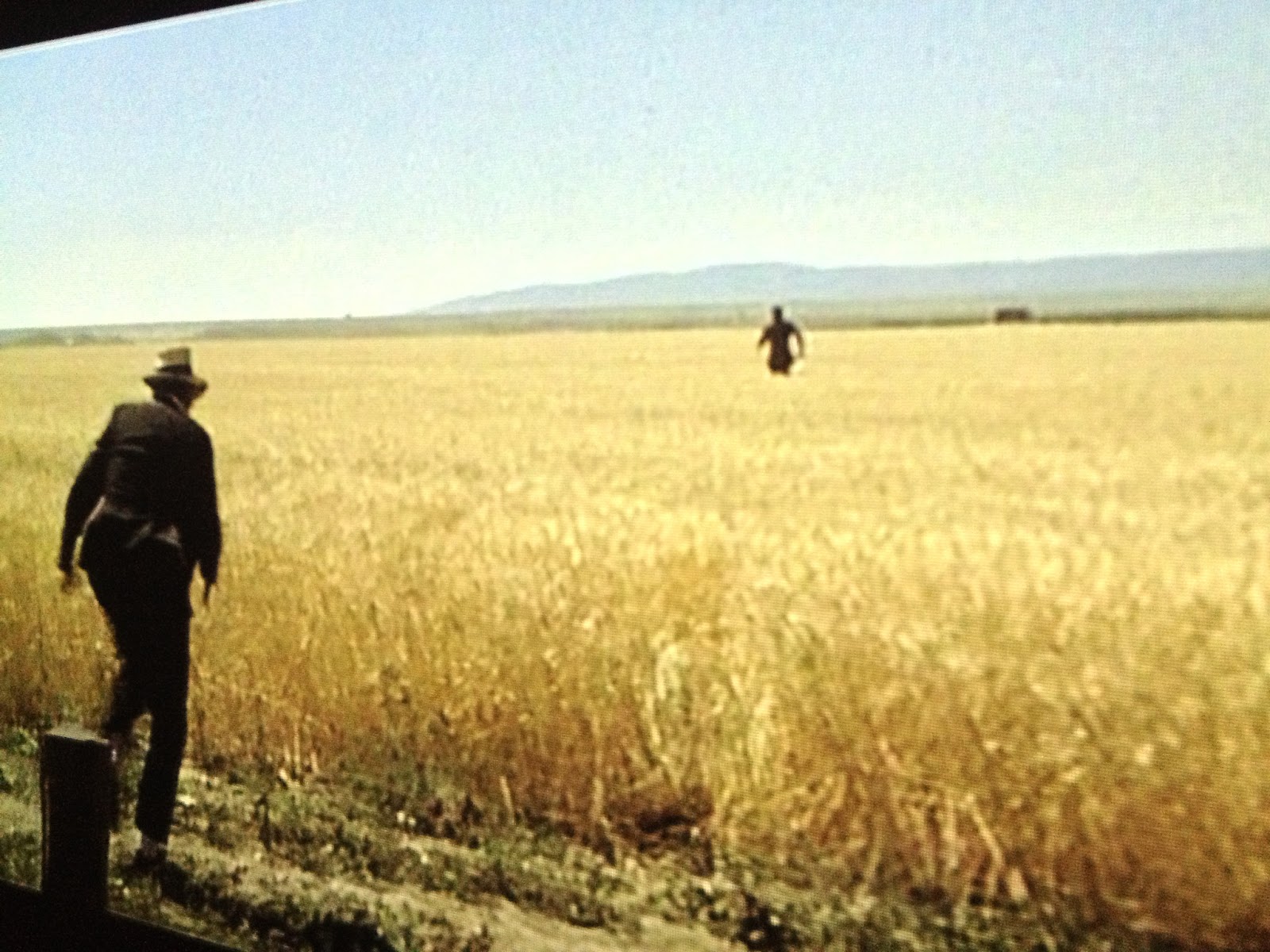
characters journey. Back at the church, the assassin has chased
Thunderbolt’ out of the church into a beautiful vista of a wheat
field.
As
He is trying to escape, Lightfoot is barreling down the road in his
direction. Without getting into details, Lightfoot hits the assassin
and picks up Thunderbolt. What I love about this scene is the
aftermath and the one shot of the dead assassin lying among the
wheat. There is no way the actor just ‘fell’ like that; from what
I have read about Cimino, the angle of the body, the placement of the
gun and most likely the symbolism of the wheat were very carefully
laid out for this shot. It’s a simple shot but for me, let’s me
know that this film is what separates an ok, forgettable film to a
great movie.
Thunderbolt
and Lightfoot’s first conversation is telling one about who and
what these characters are and why we begin to be intrigued by them
and curious to follow them:
(Lightfoot):
“I thought you were the heat!”
(Thunderbolt):
“Do I look like heat?!”
(L):
“You look like one crazy son of a bitch for a preacher, I’ll tell
you that. Who is that
guy back in the wheat?”
(T):
“An old friend.”
(L):
“With friends like that, you don’t need enemies.”
(Thunderbolt gives him a puzzled look)
(T):
“Which way are we heading?”
(L):
“WE?!!”
(T):
“All right, which way are YOU heading?”
(L):
“South.”
(T):
“South is all right with me.”
(L):
(change in tone) “You must like my driving.”
(T):
Oh I love it. Ever thought of doing it professionally?”
(L):
“What?”
(T):
“Driving.”
(L):
“Why?”
(T):
“You got blue eyes. All great race champions have blue eyes, it’s
a fact.”
(L):
“And all preachers drink like fish. That’s a fact!”
(T):
“What’s your name boy?”
(L):
“Lightfoot.”
(T):
“You Indian?”
and
this response is such a ‘key’ to why Jeff Bridges
represents the true soul of this movie:
(L): “No. Just American.”
This
the first time we hear the song “Where Do I Go from Here” by the
great Paul Williams--a song with lyrics like: ‘landscapes changed’,
‘burned bridges’ ‘nowhere for a fool to go’ and inevitably
the plaintive plea (or subtext for both characters and audience) of
‘finding the way home.’
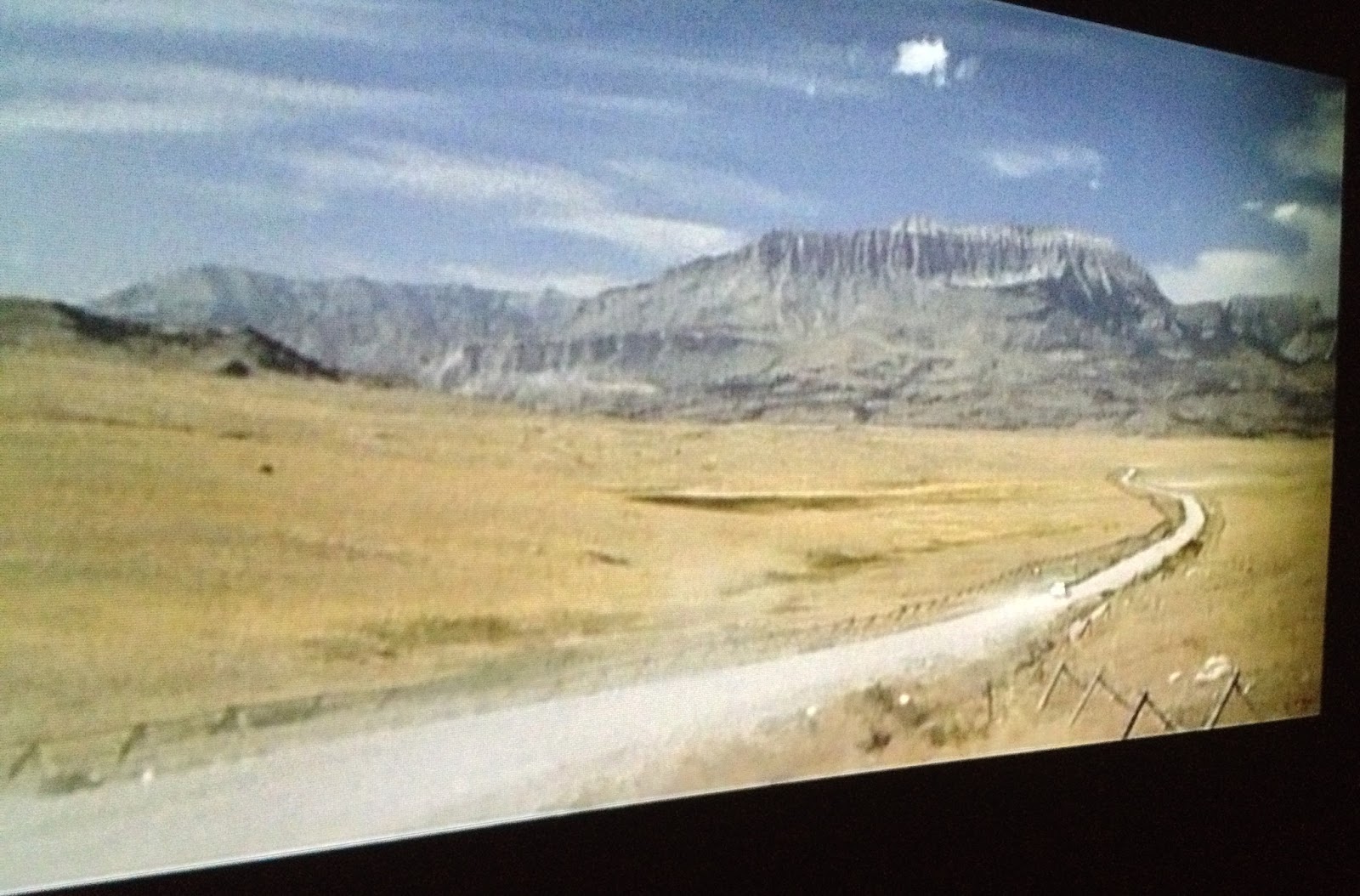
Another
long wide shot showing a road with seemingly no ‘end’ but an
imposing mountain in the far distance (future?) Simple shots/simple
characters we have watched yet this is what separates the films that
are lasting: there are no ‘throw-away’ shots; they always have a
clear vision, a ‘reason’ for every action, of who the characters
are, how they are essential to the arc of the story but most
importantly the ability to visually tell that story. You can see
glimpses, visually, in ‘Thunderbolt and Lightfoot’ of what Cimino
really had in his head; when you watch the jaw-dropping western
vistas in ‘Heaven’s Gate’ you can trace the rudimentary ideas
starting here with his ultra-wide shots.

Another
great aspect of 70’s movies is they always featured fine
supporting actors but more importantly, GREAT character actors (alot
of times the ‘fondness’ for certain character actors will make a
movie in addition to just being a great ‘comfort’ to see them
appear.) There is a suggestion that ‘character’ actors are just
‘one trick ponies’ i.e. they only do ‘one’ character or one
‘type’ of character; I could not disagree more; to me they add
the ‘depth’, the ‘shading’, the missing piece that complete
the canvas. If you want to talk about a ‘one trick pony’ actor,
watch any Kevin Costner film. Or to put it another way: picture a
cage match between Kevin Costner vs. Ed Lauter....case closed! ‘;-)
ANYWAY,
interspersed throughout the movie (and the blogpost) are a handful of
these great actors and they just really add to the scenes and the
overall richness of this movie.
“Hey,
where there is smoke there's fire”
After
stealing another car, Thunderbolt decides this is his ‘stop’ to
get out...
(L):
“You don’t know a good thing when you see it.”
(T):
“....Kid, you’re ten years too late.”
Disenfranchised
drifters (outlaws)--Thunderbolt as the old veteran and Lightfoot as
the naive young gun (in fact, later in the movie he is referred to as
‘Billy the Kid’)--clearly nomads, drifting from one ‘opportunity’
(or guise) to the next, one step ahead of lawlessness; all on a
clearly recognizable, grainy, awesome, iconic environment of 70’s
celluloid!
Another
small scene that seems innocuous but is an example of the little
things that really make-up the whole of the movie---the truckers
roadside diner (reason #125 why the Blu-Ray edition of this movie is
far overdue--HD 'frame by frame' feature to read the name of the
truck stop and the motel sign across the highway--
how else is a fansupposed to find all of the filming locations??!)
The
film was shot around Great Falls, Montana. Thunderbolt disguises
himself as a preacher at St John’s Lutheran Church in Hobson,
south-east of Great Falls (sadly it is no longer there). Lightfoot
steals his first car in Choteau. They go via Sun Canyon Road
Diversion Lake near Augusta. In the film they catch the ‘Idaho
Dream’ down the Snake River; in reality the boat was the Sacajawea
2, moored at Gates of the Mountains Marina in Helena. The bar and
telegraph office were located in Great Falls also. Lightfoot met a
hammer-wielding motorcycle girl on Ulm Bridge. Red finds out just how
vicious the department store guard dogs are at in Fort Benton. The
old one-room schoolhouse (when they finally find it) is south of
Great Falls on Interstate 15 near exit 240.
Back
to the diner and reason #378 why Jeff Bridges was nominated for an
Oscar for his performance here:
Waitress:
"What will you have?"
Lightfoot:
(flirtatious) "Four scrambled eggs…..very loose…..bacon,
toast, coffee and
american fries……you got american
fries?"
Waitress:
"yes"
Lightfoot:
(close-up with serious look) "American fries."
Just
another example how a small scene but a key scene propels this
character driven movie and really that is 70's movies at their best:
real people in very familiar situations (well, maybe except robbing
an armory or something!) but as with all of the great 70’s films,
it all starts with the written character---Lightfoot, at least from
the outside at that time would seem like a hippie i.r. as an example
of how the young people had 'lost' the 'american way' and the
ideals-- but in many ways, He is the quintessential American of the
time: disillusioned, adrift just trying to find his way and hoping to
pick the right ‘road’.
I
found this quote in a comment section on a review of the movie and
thought it echoed some of the same sentiments: it’s
nothing less than Life. When Lightfoot asks Thunderbolt "What do
we do now?" He replies “When you're not sure what to do it's
best just to drive around a while”. YES! When Lightfoot says at the
end "We made it" Thunderbolt says "For the time
being". And that IS the movie, it's ups and downs and all the
ups and downs all our real lives is only "for the time being".
That's the greater depth of this movie
"A
rolling stone gathers no moss"
Lightfoot
finally learns of the origin of 'The Thunderbolt'. By the meeting of
two more key characters Red Leary (George Kennedy) and Eddie Goody
(Geoffrey Lewis)
and
the explanation of a previous heist of the Montana Armory that He and
Red were a part of that went awry in it's aftermath.
"Beggars
can't be choosy"
Thunderbolt
takes Lightfoot to the one room schoolhouse where He had hidden the
cash from the previous heist but in the years since, it has been
replaced by a modern school--the only reason I highlight this
exchange is because at the end of the scene, Lightfoot looks up at
the school yard flag pole, chuckles and taps the hollow pole a few
times in rhythm (ok, six to be exact) and we hear that distinctive
'ping, ping' sound--whenever I pass a flag pole, ideally in a school
yard…..tragically, (just as accepting a teaching post in
Australia)….I do the same thing. See, you just never know how
'profoundly' a movie can affect you ;-)
So
far, this movie has been meandering down the 'road' until arriving at
the third act. This is where the movie really picks up momentum, not
only in its clear straight direction to the inevitable end but the
interaction of the four main characters. I like how Thunderbolt
repeats his 'opening' scripture from the beginning of the movie "And
the wolf shall lie down with the lamb." Signaling the beginning
of the end:
Goody:
"Is that a poem?"
Thunderbolt:
(gravely) "It's a prayer."
"The
rich get richer and the poor get poorer"
The
four main characters all have good chemistry together and play off
each others strength; I mean Clint is Clint which is always solid
(you know what to expect--He IS a 'movie star' as opposed to a
working actor) which is what brings us to the always excellent George
Kennedy and reliable Geoffrey Lewis. Lewis is really the conscious of
the crew, which I suppose makes sense: when he dies the group
disintegrates. Kennedy is solid in his role as Red Leary; he does not
forget a slight, ever, whether 'real' or 'perceived' and plays a
sociopath with intensity that even makes the audience
uneasy--although you need to compare his continuous simmering fury
throughout the film to a scene when Lightfoot gets back from a job a
tells the crew about the naked lady that appeared at the patio door;
Kennedy is outstanding.
Another
welcome addition is the duo play between Lewis and Kennedy---they
have a great, natural comedic touch between them:
I
am not sure how audiences nowadays would react to the
plans/preparations of the heist; it's so simple/direct and frankly
mundane but tight in it’s pace--I wonder if modern audiences would
expect or demand a more complex, Rube Goldberg type robbery or
infiltrations ala Mission Impossible? I would hope not. They would be
missing what this movie is about; not the Macguffin of the heist and
I hate to repeat myself but the brilliant direction and character
driven plot along with set pieces and places that hardly 'exist'
anymore i.e. a beer pool hall , a downtown department store, drive-in
theaters, telegraph office. They are small things but still give you
that authenticity which unfortunately movies have lost or are poorly
recreated. As mentioned before, when you find films that you 'return'
to, you just want to soak it up. That's why the tendency for
filmmakers nowadays to 'remake' classic/cult films is on one hand,
abhorrent but on the other hand, I think I understand why they do it:
they love these films so much, they want to literally 'immerse'
themselves, in a way, to try to recapture, whatever 'IT' is about how
that movie made them feel in the first place and each succeeding time
- (if I had unlimited disposable cash and some talent as a filmmaker,
it would be a hard 'drug' to turn down.)
"Red
Headed women are bad luck"
The
actual heist seems like an anti-climax to the movie (although the
actual set-ups in the Home Invasion scenes are intense, life-like &
brutal yet with that edge of style that is too often copied as
'cool'--we get the full on rage of Red that has been simmering since
we were first introduced and this in turn either kills or maims half
the crew; of course all moral judgements have been tossed aside with
Red & Goody's road trip ending abruptly. We are only left with
our original two main characters ; I don't want to give the ending
away but we are left feeling happy at some sort of redemption for our
characters but this is early 70's remember; filmmaking at it's
humanitarian best or worst depending on how cynical you are.

With
Cimino, it's a question of 'what if?' He followed this up with the
even better 'The Deer Hunter' (1978) then the financial disaster (but
very underrated film-- plus the critics of the time did it no favors)
of 'Heaven's Gate' (1980)--whether the backlash and the succeeding
label as a 'box office poison' director from the Studios led to his
demise or he was just a brilliant director that burned out too fast
(although, I would make a strong case for 'Year of the Dragon' (1985)
as very worthy addition to his oeuvre) we will never know. He just
never built upon his early brilliance but then again, if you start
your career directing Eastwood, Bridges, DeNiro, Cazale, Walken &
Streep--where do you go from there? I will take what I can get.
The
unique rhythm of the individual road movie is what always resonates
with me and is what compels me to keep ‘returning’ to this genre
and each individual ‘journey’ again and again; it’s a trip I am
always available to go on and one I never tire of making.
Of
course, if none of the above has convinced you to give this film a
chance, maybe my friend Edgar Wright can sway you??!: